Strengthening the spiritual healing of indigenous communities
Published on 29 May 2017
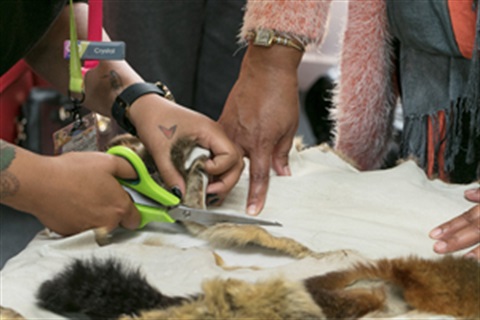
Maribyrnong’s First Nations community will come together this week for an arts based project that honours and celebrates local Indigenous history.
Over the past decade, Council has supported and celebrated local Indigenous Australians in a range of ways, in consultation with the Maribyrnong Reconciliation Group.
Since 2015, support has been provided to the cohealth Aboriginal and Torres Strait Islander Health team, and in 2016, an artwork designed by local Aboriginal artist Ngardarb Francine Riches was installed and launched at Braybrook Community Hub as part of this partnership.
Following the success of the artwork and the partnership with cohealth, a new arts based project has been developed in consultation with the Maribyrnong Reconciliation Group and the local community in an effort to celebrate and honour local Indigenous history.
The cohealth Possum Skin Cloak Project was established to promote spiritual healing, with a goal of creating an adult and child size cloak. The cloaks are being made by local Aboriginal and Torres Strait Islander community groups during workshops held both at Maribyrnong Library and at cohealth Arts Generator based at Footscray Community Arts Centre.
Steeped in 5,000 years of tradition, ritual and cultural knowledge, the possum skin cloaks were traditionally made where there was a cool climate and an abundance of possums, predominantly in South Eastern Australia, from Northern NSW down to Tasmania and across to the southern areas of South Australia and West Australia.
The cloaks, which were made from numerous possum pelts often sewn together with kangaroo sinew, were imbued with the cultural stories of the wearers. As well as being a means to keep warm, the cloaks held significance within the groups as they were handed down through generations as heirlooms.
However, the making and wearing of possum skin cloaks declined in the 19th century as Indigenous people became dispossessed of their land and started living in missions throughout Australia, which saw the distribution of clothing and blankets. This, coupled with the fragile nature of the cloaks and the fact that many Aboriginal people chose to be buried with them, has resulted in few original cloaks remaining today.
But the cultural identity of Aboriginal communities has strengthened thanks to the continuing practice of making and wearing possum skins.
Uncle Roy Alexander, a Yorta Yorta elder who was the Maribyrnong Citizen of the Year in 2015, is passionate about the Possum Skin Cloak Project.
“Making these cloaks will bring people from all different tribes together. Our mobs are the ‘scattered tribes’ displaced from country for a whole range of reasons. Doing this together supports people to think about their ancestors and this will make us all stronger,” Uncle Roy said.
The possum skin cloaks will be kept at cohealth Arts Generator for community use for events and ceremonies through the West and beyond.
Reconciliation Week 2017: Possum Skin Cloak Making
To celebrate Reconciliation Week 2017, join us to witness a unique participatory arts project that uses possum skin cloak making as therapy.
This event will showcase the process of making possum-skin cloaks with a focus on their purpose and ceremonial uses. The story of creating the cloaks will be given by Ngardarb Francine Riches, a visual artist for over 30 years from the Arriyol clan of the Bardi Jawi from her mothers people and Karajarri from her father’s people in the West Kimberley.
When: Friday, 02 June 2017 | 10:30 AM - 01:00 PM
Location: VU at Metro West, 138 Nicholson Street, Footscray 3011
More info
The Possum Skin Cloak Project is a community led project with support from Maribyrnong City Council and cohealth.
Message from the Mayor - Cr Catherine Cumming
“Council is committed to supporting our community, and we are proud to be able to support Indigenous elders in the western suburbs of Melbourne to navigate the experience of reconnecting with indigenous culture and the land of which they were dispossessed.”
Maribyrnong News
Stay up-to-date with the latest news by subscribing to our eNews.