Frequently Asked Questions About Bunbury Street Works
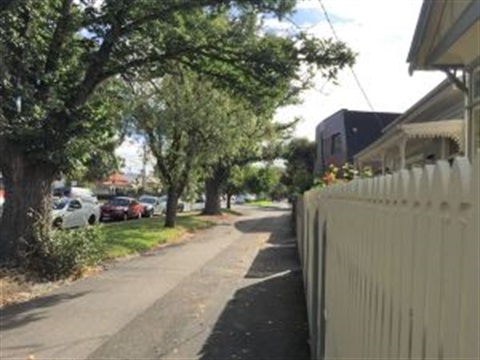
Below you will find frequently asked questions and the answers about the Bunbury Street works.
If you can't find what you're looking for below please visit our online community engagement platform, Your City our Voice, or contact Council's City Design Team by phoning 9688 0200.
Why is Council upgrading Bunbury Street?
The project was initiated due to multiple factors:
- The health of many trees is deteriorating, which impacts on the heritage and landscape character of the street in the long term. The street upgrade will implement a long-term succession plan to reinstate the avenue in the streetscape.
- As part of a housing growth area, an expanding arts precinct, construction of Footscray Wharf, Bunbury Street is experiencing increased pedestrian and cycling traffic. The overall project extent is shown in the figure below.
Why is the health of the street trees in a state of decline?
Council has undertaken multiple detailed arboriculture investigations into the condition of the tree avenue in Bunbury Street. Independent assessments found that many trees have been adversely affected over many decades by historic rail tunnel construction, poor pruning practices, challenging soil conditions, drought, and changing climate conditions. These factors have resulted in declining tree health and increasing structural risk.
What engagement was undertaken with the community?
A thorough engagement process encompassing the residents of Bunbury Street and the broader area, relevant stakeholder groups and committees was undertaken in the development and feedback process for the draft concept design options:
- Initial community engagement May/June 2021 informing residents about the poor health of street trees, strategic context and querying community desires for the future streetscape.
- Notification to residents regarding emergency tree removals completed in August 2022.
- Consultation on three draft concept options in November/December 2022 including three in-person drop-in sessions.
- Targeted engagement (door-knocking) with Bunbury Street residents regarding the Options in April 2023.
- In addition, feedback was sought from stakeholders including the Footscray Community Arts Centre, Artlife Group, Heritage Advisory Committee, Indigenous Groups, Australian Rail Track Corporation (ARTC) and Metro Trains.
What were the outcomes of the community engagement?
As part of the community consultation undertaken between 2022-2023 and endorsed by Council in July 2023, the feedback from the community supported the proposed landscape concept to:
- Dedicated bike lanes are not required in Bunbury Street
- Retain the existing healthy trees in fair condition
- Plant an alternative tree species that will provide a large canopy and are climate suitable but respectful of the streets heritage value in the gap areas
- Plant colourful and flowering planting in the new kerb extensions
- Include either a mown grass and native planting aesthetic in understorey verges
- Introduce a second row of smaller trees next to the footpath, where space permits
- Undertake a review of parking restrictions in the street
What were the key features of the endorsed concept design in 2023?
Among the three concept options presented to Council in 2023, Option 1 - Light touch was endorsed. Its key features include:
- Reconstruction and repairs of footpaths, kerb and channel along Bunbury Street
- New kerb extensions and additional landscaping at intersections as well as footpath improvements to reduce crossing distances
- Staged renewal of the avenue trees using climate-resilient species to restore the main avenue
- Planting of a second row of smaller trees adjacent to the footpaths
- Street lighting upgrades and power line management (bundling)
- Cyclists and vehicles sharing the road in a low-speed environment;
- Incorporation of First Nations artwork within the streetscape
- Reconstruction of the Bunbury Steet frontage adjacent to the Ryco development
- A new access ramp to the Footscray Community Arts Centre
- A shared user path within Grimes Reserve
- Maintaining on-street parking
Are Elm and Ash trees part of the long-term tree succession plan for the street?
- As a living landscape element, trees develop and mature, reaching over-maturity and senescence at a period determined by the species and environmental conditions. The eventual loss of significant trees from the landscape is unavoidable.
- The existing Elm trees are an exotic species that is not well suited to the warming Australian climate.
- The existing Desert Ash are an invasive species, and replanting this species like-for-like should be avoided.
- In line with Council's Urban Forest Strategy (2018) that emphasises the need for biodiversity and climate appropriate planting, Elms and Ash trees do not form part of the tree succession plan.
Will Council maintain the existing alignment of the streets trees?
New trees proposed along the street will not align with the current alignment of the street trees. Rather they will sit centrally within the verge. This will ensure:
- Establishment of a better more balanced and healthier tree canopy with stronger root system as central verge will provide greater soil volume.
- Reduced risk of conflicts of tree roots with the drainage infrastructure by increasing the separation.
- Improved chances of survival of the small second row of trees by increasing the separation with the large canopy tree.
What is the criteria for the selection of new species?
To inform the selection of replacement species for trees of heritage significance, a modelling of the tolerance of tree species under future climate scenarios has been used.
In addition to the future climate tolerance, consideration of the form and characteristics of trees to be replaced is of primary importance, as heritage significance often lies in aesthetic values. To recreate these values, foliage texture, density, colour and retention (evergreen vs. deciduous) is considered, to achieve a replacement planting comparable to the original.
Based on this, expert advice has suggested several Oak varieties as worthy replacement species for Bunbury Street.
What species will be planted?
Based on the criteria outlined in the above FAQ, a mix of Quercus acutissima (Sawtooth Oak) and Quercus Canariensis (Algerian Oak) are proposed to be planted as the main avenue tree. We are currently seeking input from residents on the preferred tree species for the street.
In addition, Council will plant a double row of trees to enhance the streetscape character and build greater resilience into the streetscape.
What works are included as part of implementation of Stage 1 construction?
Council will be commencing works to deliver Stage 1 (Footscray Station to Whitehall Street) of the streetscape renewal plan, including:
- reconstructed footpath on the north side of the street
- kerb extensions, flat top crossings and new landscaping at Cowper Street - Bunbury Street intersection
- kerb and channel repairs along the street and general road drainage improvements
- removal of two trees and potential removal of their infill trees based on community feedback
- new avenue tree plantings along the extent of Stage 1
- small tree planting at the edge of the footpaths
- First Nations pavement artwork in key locations
The work is expected to start in late September 2026 and completed in December 2026, weather permitting.
Has Council undertaken any works in the street to date?
Council has undertaken initial works along the street in early 2026 including:
- The Grimes Reserve Shared User Path was formally extended from Levien Lane south to Maribyrnong Street to better connect pedestrians and cyclist to the Maribyrnong River Trail.
- The powerlines along Bunbury Stret have been bundled into a single power cable to significantly reduce the amount of pruning required. This will help preserve larger, healthier tree canopies and an overall improved tree health into the future.
How many new trees will be planted as part of Stage 1 works?
As currently planned, 46 new trees, including the main avenue trees and smaller secondary trees, will be planted as part of the Stage 1 works. This number may vary slightly, as some smaller trees located beneath the canopy of large existing trees may not be planted due to their low likelihood of survival.
Will the new trees planted be mature trees?
Council will plant 100 litre trees (approximately 2-3m in height) as they are more adaptable, establish faster and often catch up in growth to larger trees within a few years.
Is Council undertaking further arborist assessments of the existing trees?
Yes, Council will continue to undertake arborist assessments of the existing street trees every 2-3 years to be able to best manage and monitor their health.
What kind of artwork is included in the streetscape?
As a reflection of the history and significance of the street and the proximity of the art precinct Council has incorporated public art on the pavement by selected First Nations Artist Iluka-Sax-Williams.
The artwork will be delivered on the footpath at the four corners of the Cowper and Bunbury Street intersection.
Are there any trees being removed as part of the proposed works?
Two trees identified in the picture below must be removed because arborist assessments have identified poor health and end-of-life condition. These trees were heavily pruned in 2022 to reduce the risk posed.
Council is seeking community feedback before making a final decision on three additional small infill trees identified below. While these three English Elms are in fair to good health, they are juvenile (were planted recently).
These trees have been identified for potential removal because they do not align with the endorsed long-term succession plan for the street.
Community feedback, arborist advice, design considerations and construction requirements will be considered before a final decision is made.
Will Council review the parking restrictions in the street?
There are no recorded instances in 2026 of average parking occupancy (measured between 10am and 4pm) exceeding 85% of all spaces between Hyde Street and Cowper Streed (signed 2P).
Furthermore, parking occupancy seems to decrease after 6pm based on the sensor data.
Based on the data and referring to Council's Parking Management Policy 2017, this current parking demand does not justify further tightening of parking restrictions on this segment of Bunbury Street.
Having said that, residents in the street are eligible to apply for resident parking permits.
How can I provide feedback on the tree removals and tree species?
You can provide feedback by: